
.jpg?width=300&name=website-032026-OGGN_Podcast_Website%20Hero_new%20(1).jpg)
From Vision to Execution: How NavVis is Helping Cut the “Mean Time to Reality” at ExxonMobil
ExxonMobil × NavVis
Oil and Gas Global Network (OGGN)
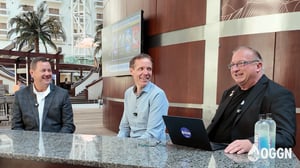
Finn Boysen, CRO of NavVis, joined Michael Hotaling of ExxonMobil for a conversation on the OGGN podcast.
Michael is an Executive Advisor at ExxonMobil focused on Technology Scouting, Innovation, and Ventures.
In this conversation, they discuss how ExxonMobil and NavVis are partnering to shorten the “Mean Time to Reality” – helping turn digital ambition into operational value by building a digital twin foundation at a global scale.
Building one of the largest digital twin foundations in the world
Finn’s discussion with Michael centers on how ExxonMobil is working with NavVis to reshape the way it connects digital strategy to day-to-day operations.
Michael introduces a concept he calls “Mean Time to Reality”: the time between vision and execution. In large industrial organizations, ideas are rarely the constraint. The challenge is how long it takes for models, plans, and digital initiatives to become usable in the field.
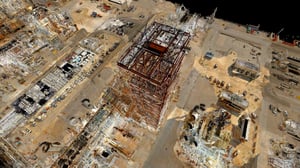
Reducing that time is now a strategic priority for ExxonMobil as it moves forward with what Michael describes as the largest digital twin foundation in the world – built not as an isolated deployment, but as core infrastructure intended to support operations across the enterprise.

From Maps to Living Models
To explain the shift, Michael points to the evolution of navigation apps. They once helped drivers move from point A to point B. Today they are contextual, continuously updated, and informed by multiple integrated data sources.
Digital twins must follow that same trajectory. A static model has limited impact. A useful one reflects current conditions, supports decisions, and connects into broader enterprise systems. Michael also emphasized that this approach helps break down operational silos by giving teams a shared, visual reference point grounded in physical reality.
Interoperability and open standards are essential to making that sustainable. Capture, storage, processing, and consumption cannot live inside closed ecosystems if the goal is enterprise-wide adoption. That principle aligns directly with NavVis’s own approach: reality data should be accessible, portable, and ready to integrate across systems.
"We are in the process of executing, probably, the largest digital twin foundation in the world."
Reality Capture and Reality Access at Scale
That vision depends on effective reality capture and reality access – areas where NavVis now plays a central role.
Finn explains how NavVis delivers mobile capture that is up to 10x faster than traditional static workflows while still reaching accuracy levels validated against terrestrial laser scanners. The resulting scans are processed and optimized through industrial-grade software pipelines, delivered at the resolution and performance required for industrial environments, and made accessible in a way that allows teams to explore, validate, and collaborate at scale, potentially for thousands of users worldwide.
Only a few years ago, digitizing industrial facilities at this level was both cost-prohibitive and time-prohibitive. Today it is operationally feasible and economically viable. ExxonMobil is moving decisively at this inflection point, embedding reality capture into how it plans, verifies, and executes work.
What This Enables for ExxonMobil’s Workforce
Michael speaks candidly about workforce expectations. Employees want to move beyond static documentation and dense manuals that contribute to cognitive overload. They expect visual interfaces, contextualized information, YouTube-style learning, and GenAI-style querying – tools that align with how they already consume information outside of work.
He summarizes the standard clearly: “It’s not about the technology. It’s about whether you’ve changed the way you work."
NavVis supports that shift by making reality accessible, intelligible, interoperable, and engineering-ready – enabling ExxonMobil to reduce its Mean Time to Reality and build a digital twin foundation that can serve both current use cases and those still ahead.