

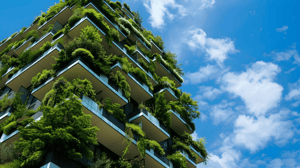
When we talk about sustainability, the conversation often turns to renewable energy or low-emission transport. Yet one of the biggest opportunities to reduce our global environmental impact lies all around us: the buildings we live and work in.
The construction and buildings sector is responsible for around 40% of global energy- and process-related CO₂ emissions and 35% of global waste generation. These numbers make one thing clear — achieving sustainability goals depends heavily on how we build, operate, and renovate our spaces.
The hidden cost of building new
At first glance, new construction seems like a clear path to sustainable design. A new building can be energy efficient, smart, and compliant with the latest environmental standards.
But new construction also comes with a hidden cost: embodied carbon — the emissions generated by producing and transporting building materials, and by the construction process itself. In fact, around 40% of a building’s total lifecycle energy use and CO₂ emissions are generated during the shell construction phase, emissions that are largely avoided when renovating instead of rebuilding. Every time a structure is demolished and rebuilt, all of that embodied carbon is lost and recreated.
In many cases, tearing down an existing building to start from scratch means starting over environmentally, too.
Renovation: sustainability’s most powerful tool
Renovating and reusing existing buildings can significantly reduce environmental impact while creating modern, efficient spaces. Here’s why renovation is often the more sustainable choice:
- Preserving embodied carbon: Keeping existing structures reduces the need for new materials — and the emissions associated with producing them.
- Reducing waste: Renovation prevents demolition waste and supports circular construction practices by extending the life of materials and components.
- Leveraging what we already have: Many existing buildings — particularly older ones with outdated insulation, heating or ventilation — can be retrofitted to meet modern energy-efficiency and comfort standards. Empirical studies show that retrofit investments often deliver solid energy savings and attractive returns (frequently within 5–10 years), especially compared with the high embodied carbon and upfront costs of new builds.
- Accelerating progress on regulation and certification: From the EU Taxonomy to LEED and BREEAM, sustainability frameworks increasingly recognise renovation and reuse as key strategies for decarbonisation.
Technology makes sustainable renovation possible
Modern renovation projects depend on accurate knowledge of existing building conditions and efficient digital collaboration. Technologies such as reality capture, digital twins, and streamlined BIM generation enable a workflow that makes sustainable refurbishment faster, more transparent, and more resource-efficient.
- Precise, fast reality capture: Wearable mobile scanning systems like NavVis VLX capture high-accuracy 3D data in a short time, providing the factual foundation for sustainable decision-making.
- Immediate digital access through a building twin: Uploading the captured data into platforms like NavVis IVION creates a cloud-based digital twin accessible to all stakeholders. This enables remote site exploration, fewer physical visits, better coordination, reduced travel emissions, and less rework — ensuring everyone works from the same up-to-date information.
- Accelerated BIM modeling: Reality-capture data can be quickly transformed into structured BIM models. This gives architects and engineers a reliable digital foundation.
The impact
Together, rapid capture, cloud access, and fast BIM generation allow teams to:
- Understand building conditions early.
- Gain insights into environmental impacts.
- Make better choices about reuse, replacement, and materials.
- Collaborate in a shared, reality-based workspace.
This technology-driven workflow ultimately makes sustainable renovation more efficient, more transparent, and more scalable.
At NavVis, we’ve seen these workflows in action through real-world projects. For example, Allinq Digital used NavVis wearable laser scanning and digital twin workflows to support sustainability-driven renovation planning at Amsterdam’s Schiphol Airport. By capturing high-accuracy 3D reality data and generating detailed BIM models of complex facilities, the team dramatically reduced modelling costs and made data-driven planning economically viable for extensive retrofit and renovation work. The resulting digital deliverables are now being used by Schiphol and its contractors to plan upgrades more efficiently, streamline construction processes, and support long-term sustainability goals — unlocking the benefits of digital refurbishment without the environmental and operational disruptions of traditional methods.
A global shift toward reuse
In regions like the Nordics, renovation-first strategies are already becoming standard. Sweden, for instance, now requires embodied carbon reporting for large new buildings — a regulation that strongly encourages reuse and renovation. Across Europe, and increasingly in North America and Asia, investors and building owners are recognising that the most sustainable building is often the one that already exists.
The way forward
Sustainability in construction isn’t only about how we build new — it’s about how we extend the life and value of what we’ve already built.
By rethinking renovation and harnessing digital technologies to make it smarter and more data-driven, the industry can take a major step toward its net-zero goals.
Because in the end, building better starts with building less — and reusing more.