


A Q&A with Asim Akram, 3D-scanning specialist at Multiconsult
For complex buildings, reliable documentation depends on more than isolated files or drawings. Teams need a clear, accessible way to understand the spaces they manage, maintain, and operate.
That was the focus of Multiconsult's work for the Hotel Continental in Norway. The team set out to create a complete and accurate 3D scan of the building to improve overview, documentation, and management across its many rooms and technical areas.
Project snapshot
- Building: Hotel Continental, Norway
- Property size: 16,000 m² / approx. 172,222 ft²
- Scope: Every room and technical space
- Technology used: NavVis VLX, NavVis MLX, and NavVis IVION
- Outcome: A complete digital twin to support documentation, maintenance, and day-to-day building operations
- Key workflow: Capture, visualize, collaborate, and tag important areas with points of interest
Asim Akram, 3D-scanning specialist at Multiconsult, shared how the project came together, what helped the team make progress, and what advice he would give to others working toward similar outcomes.
Q: What were you tasked with, or what did you aim to achieve?
We were tasked with creating a complete and accurate 3D scan of the Hotel Continental.
The hotel includes many rooms and technical areas, so the main objective was to give teams a better way to understand and manage the site. A detailed digital twin could improve the overall overview of the building, support more reliable documentation, and make information easier to access for the people responsible for ongoing operations.
The aim was to create a visual reference that reflected the actual building conditions and could support practical work after the scanning was complete.
Q: What contributed most to the project’s progress?
The biggest factor was the combination of advanced scanning technology and a digital platform that made the captured data easy to use.
For scanning, we used NavVis VLX and NavVis MLX. This helped us capture different types of spaces across the building, including rooms and technical areas that required detailed documentation.
The digital platform then made it possible to visualize the captured data, collaborate around it, and tag important areas with points of interest. That made the information easier to navigate and gave users a more structured way to find what they needed.
The ability to add POIs was especially useful because it allowed key locations and details to be marked directly in the digital environment. This made the model more useful for teams who needed to understand specific parts of the building without searching through disconnected files or notes.

Asim Akram, 3D-scanning specialist at Multiconsult
Q: What results or progress did you see?
In the end, we delivered a detailed and accessible digital model of Hotel Continental.
The model gives teams efficient access to building information and helps simplify maintenance workflows. It also supports smarter building operations by making it easier to understand rooms, technical areas, and relevant site details from one visual environment.
For a complex building, this kind of access can make day-to-day work more efficient. Teams can review spaces remotely, locate relevant information more quickly, and use the digital twin as a shared reference when planning or coordinating work.
The result is a building model that supports documentation, maintenance, and operational decision-making in a more practical way.
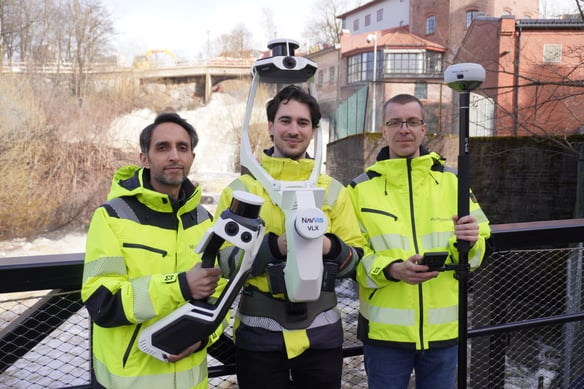 Asim Akram, Harun Custic, and Martin Adam Martinsen from Multiconsult
Q: What advice would you give to someone trying to achieve similar outcomes?
Focus on accurate data capture and a user-friendly platform from the beginning.
High-quality scan data is essential, but the value becomes much stronger when people can easily access, understand, and work with that data. A digital twin should be easy to navigate, simple to enrich with context, and useful for the teams who will rely on it after the project is delivered.
For anyone planning a similar project, the key is to think about the full workflow: how the building will be captured, how the data will be organized, and how different stakeholders will use it in practice.
Conclusion
The Hotel Continental project shows how digital twins can support more effective building documentation and operations when accurate reality capture is paired with accessible digital workflows.
By using NavVis VLX and NavVis MLX, and by organizing the captured data in a platform that supports visualization, collaboration, and POI tagging, Multiconsult delivered a detailed model that makes building information easier to access and use.
For teams managing complex buildings, that accessibility is where much of the operational value comes from.
Ready to see how NavVis can transform your own workflows?
