

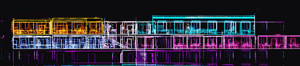
Reality capture projects often involve more than one walk, especially when teams are working across multiple floors, zones, phases, access routes, or return visits to the same site.
Each walk may be accurate on its own, but the final deliverable also depends on how well those datasets align into a single, connected result.
With our Summer ’26 Product Update, NavVis introduces Cross-Dataset Alignment (CDA), a new NavVis IVION Processing feature that helps automatically align multiple NavVis datasets within a single processing task.
CDA reduces the effort traditionally required to bring datasets together, both on site and in the office. That can mean less time spent planning and setting up extensive control, less manual stitching after processing, and fewer time-consuming alignment steps before the data is ready to use.
When teams capture with alignment in mind, using appropriate reference points, sufficient overlap, and loop closures where needed, CDA leverages that additional information to automatically optimize alignment across datasets during processing.
For teams working with multiple datasets, the result is a faster, more scalable way to turn multiple datasets into one accurately aligned deliverable.
How Cross-Dataset Alignment works
CDA works during processing, when multiple datasets from one or more NavVis dynamic laser scanners are uploaded to NavVis IVION Processing.
It analyzes how different datasets relate to each other through common reference points, geometry, and overlapping trajectories or “loop closures”. The datasets can then be optimized together as part of one connected processing workflow.
For multi-walk projects, this changes where much of the effort sits. Instead of treating each walk as a separate piece that needs to be manually aligned or adjusted after processing, CDA helps datasets align earlier in the process.
Plowman Craven, a leading survey company in the UK, has been an early customer voice on CDA. Mark Wakeling, Technology Innovation Director at Plowman Craven, described the workflow value this way: “With CDA, the data can snap together in the processing phase. It understands how the jigsaw goes together.”
CDA also builds on a familiar surveying principle: using common points to bring scans together. Survey professionals already know this from target-to-target point cloud registration. With CDA, that logic becomes part of NavVis IVION Processing, making it easier to scale across larger multi-dataset projects.
Where CDA helps most
CDA is especially valuable on projects where teams need several walks to become one coherent deliverable.
That includes multi-story buildings, transportation hubs, hospitals, airports, campuses, industrial facilities, construction sites, and other complex or continuously evolving environments. Dynamic reality capture has already made these sites faster to document in the field. CDA helps the processing and alignment workflows keep pace by bringing multiple datasets together earlier, with less manual alignment work.
This matters for as-built documentation, scan-to-BIM, surveying, facility documentation, progress tracking, virtual walkthroughs, immersive visualization, and long-term spatial records.
Plowman Craven saw this clearly on a project involving around 25 metro stations in Singapore, with multiple walks required for each station. “When we look at our experience in Singapore, the time spent aligning the point clouds was more than the time spent doing the walk,” Wakeling explained.
He also connected CDA to the way customer deliverables are changing: “As we move to delivering splats and virtual tours, it is going to be more important that the entire experience stacks up.”
CDA is also valuable where traditional control setup is difficult or time-consuming, such as staircases, tight corridors, ceiling voids, service shafts, hazardous areas, complex indoor spaces, or GNSS-limited environments. In these conditions, CDA helps teams keep larger projects moving while supporting reliable alignment across datasets.
For surveyors and laser scanning professionals, that means a more efficient way to deliver large projects with confidence as well as better throughput and project capacity. For construction and enterprise teams, it supports more repeatable capture workflows across expansive floors, zones, phases, sites, and portfolios.
Reducing control effort from the workflow
Surveyed control remains an important part of many professional reality capture and surveying workflows. CDA does not remove that reality, and it does not replace the need for good field practice.
The difference is that teams may not need to spend as much time setting up control everywhere just to bring datasets together. Depending on the project, they may be able to reduce the amount of surveyed control they need, use control more selectively, or avoid it all together.
That flexibility was one of the clearest benefits for Mike Lammers, Project Lead at Geelink Coenradie B.V. He explained that most of their projects consist of multiple datasets, and that they were looking for a way to connect those datasets without relying on surveyed control points at every connection area.
“Placing and measuring GCPs at connection areas is often difficult and time-consuming,” said Lammers.
During testing, Geelink Coenradie found they only needed to use surveyed control in one dataset and align other datasets to that one. For Lammers, this was “a major step forward” that “significantly improved our workflow.”
That is the practical value of CDA: teams can adapt the amount of control to the project while reducing overall alignment effort, from field setup to office-side checking and correction.
From field capture to final deliverable
CDA helps teams carry the efficiency of fast data capture through to project delivery by additionally reducing the effort needed to align multiple datasets.It also complements the broader NavVis IVION workflow, helping teams carry efficiency gains from capture through processing and into data review.
Once datasets have been aligned and processed, capabilities such as Hide Overlap and Point Cloud Cleanup help create cleaner, easier-to-use site data by reducing visual clutter and removing unwanted artifacts.
The result is a more streamlined path from capture to final deliverable. With less time spent on control setup, manual alignment, and dataset refinement, teams can move from multiple scans to accurate, aligned site data more efficiently - helping reduce project effort while maintaining confidence in the final result.
To learn more about Cross-Dataset Alignment in NavVis or speak with our team, reach out to us here.